The Sentinel Palm

Portrait · trunks · Looking up the trunks of mature areca — pepper vines spiralling into the mist

The palm the estate is built on.

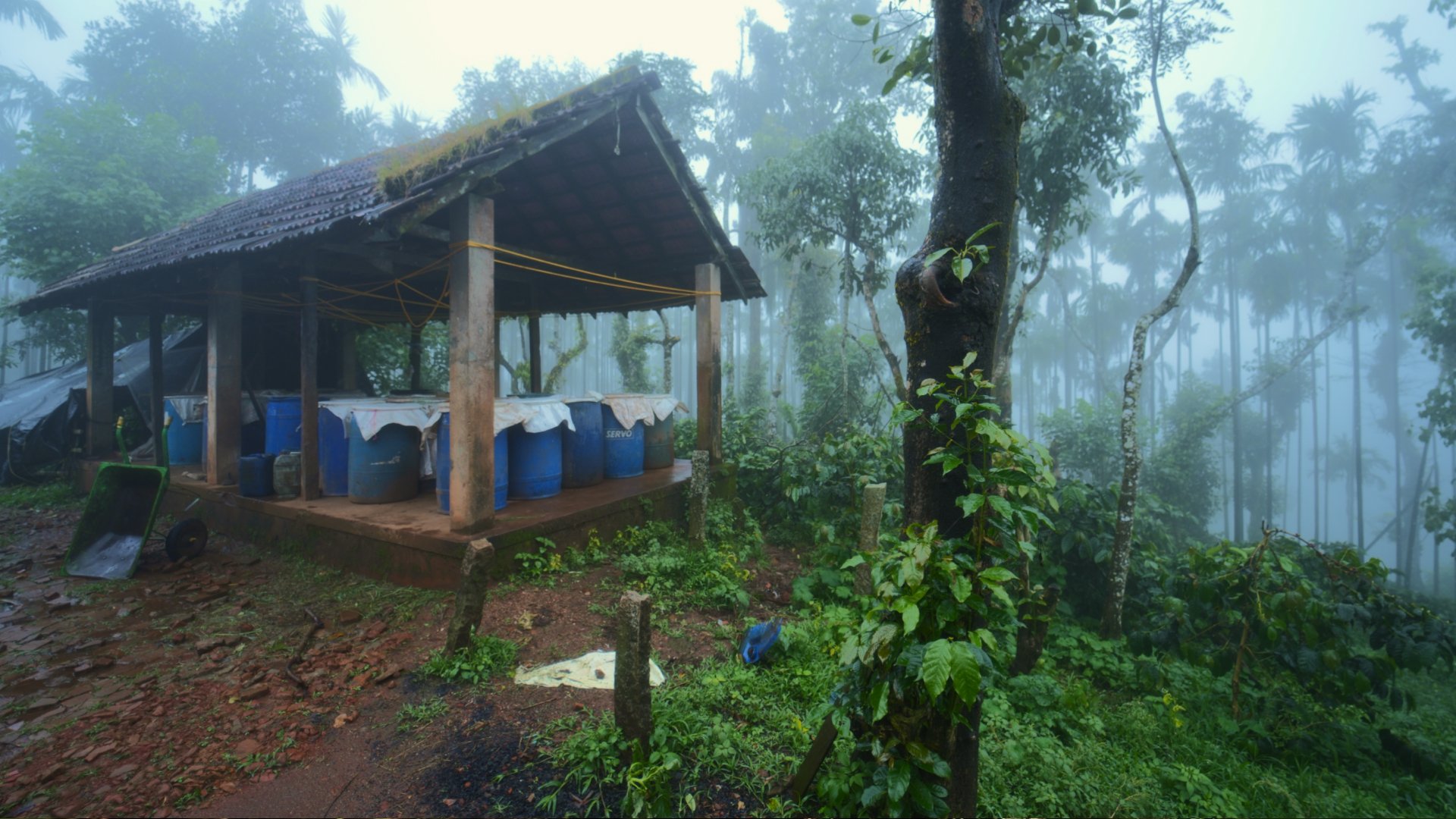
At Mudigere the areca palm is the tree the whole plantation stands on. It grows straight — 15 – 20 mon a single vertical axis for its entire life — and Aura works it as the estate's mid-canopy, the layer every other crop hangs off. It never wins a cupping score and never shows up on a menu. It holds up the ones that do.

Aura did not plant areca as a cash crop. We planted it because no other tree holds up the system we were building. The mid-canopy is the load-bearing layer of the plantation — pull it out and the stack comes down. In that layer the palm does three jobs at once.

Trellis

The living scaffold the pepper vine climbs. No manufactured trellis matches the rough-bark grip of a mature trunk, and none composts back into the soil when its work is done.

Shade filter

Dappled light, not direct. The Arabica beneath ripens slower under areca shade — the extra weeks that put the score on the cupping table.

Mulch source

Fallen fronds and leaf sheaths break down into a fibrous mulch that holds moisture, suppresses weeds, and feeds the worm beds below. The tree settles its own ground bill.
The tree grows straightso that everything elsecan afford to bend.

Karnataka's answer for a thousand years.

Areca is not a neutral tree here. Its nut (adike in Kannada), wrapped in a betel leaf, is offered at weddings, at temples, at the start of a conversation with an elder — a small formal gesture older than anyone can date. In the coastal and Malnad districts, a household's areca grove is at once a bank account and a family record.

Aura grows it aware of that lineage. For a thousand years areca has been this landscape's answer to “what shall we plant?” — we are not introducing it, we are continuing it. That is the estate's method in one tree: the oldest answer in the district, kept and measured rather than replaced.

Everything else grows in its shade.

ಎಲ್ಲವೂ ಅದರ ನೆರಳಿನಲ್ಲಿ ಬೆಳೆಯುತ್ತದೆ.
Process · drying yard · A raised bamboo platform in morning light — thousands of nuts turned and raked

White, red, nothing wasted.

The nut leaves the palm along one of three paths.

Chali · white

Fully ripe nuts, dehusked and sun-dried for weeks on raised platforms. The white areca — the coastal grade.

Kempadike · red

Tender green nuts, boiled and dried to a deep red. Firmer, higher in tannin. The red areca — the Malnad grade, the one this district has always made.

Closed loop

Husk fibre for rope and board, leaf sheaths for biodegradable plates. The apothecary and the kitchen take what the market does not. The tree leaves nothing behind.

A tree you plant for someone else's coffee.

An areca takes five to seven years to bear its first useful nut, and longer before its trunk roughens enough for a pepper vine to trust. Plant one today and you are planting shade for a block that will not exist for a decade. That is not a complaint. It is the estate's whole logic written as a planting schedule.

A palm Aura plants this year will still be the mid-canopy in the 2050s, holding up coffee that has not been laid out yet. We plant on that horizon on purpose.

Not a monocrop. A spine.

On some estates areca is the only crop. Not here. At Aura the palm is the spine of the mid-canopy, and its economics are part of the coffee and the pepper, not separate from them. When a season is hard on coffee, the areca holds the books. When areca prices fall, the coffee carries. The whole organism is sturdier than any single crop in it.

The sentinel palm is the quiet one. It never shows up on a cupping sheet and never wins a score. But pull it out and the plantation comes down. A plantation that leans on one tree is fragile; a plantation held together by one is sturdy — the difference is which way the dependency runs.